
A will is legally valid in California if it is written, signed by a mentally competent adult aged 18 or older, and witnessed by two adults who are present at the same time, as required under California Probate Code §6100–6113. In simple terms, if any of these elements are missing, the will may be deemed invalid in court.
According to a 2024 AARP study, 55% of American adults still don’t have a will, and among those who do, nearly 1 in 5 self-prepared wills fail to meet basic state requirements, often due to improper witnessing or missing signatures.
California courts handle thousands of probate disputes each year over wills that don’t meet these legal standards, disputes that can delay inheritances and fracture families.
At The Estate Lawyers, APC, we make sure that never happens to your family. Our team has more than 150 years of combined courtroom experience, and are California’s trusted authorities in trust, probate, and elder law litigation.
We’ve built our reputation by fighting for families, safeguarding rightful inheritances, and holding wrongdoers accountable in the courtroom. From handwritten wills to complex multimillion-dollar estates, we make sure every legal document meets California’s strict standards, so your wishes stand firm when it matters most.
Key Takeaways
- California wills must be written, signed, and witnessed.
- Handwritten or digital wills carry legal risks.
- Small errors can void a will entirely.
- An estate lawyer makes sure your wishes hold up in court.
What Is a “Valid Will” Under California Law?
A valid will in California is a written document created by an adult who is at least 18 years old, of sound mind, that is signed and witnessed according to California Probate Code §6100–6113. The will must clearly express the testator’s intent to distribute their property after death and comply with all signature and witness requirements.
Under California Probate Code §6100(a), any person 18 or older who is of sound mind may make a will. This means the person must:
- Understand the nature of making a will
- Know the extent of their property
- Recognize their heirs and beneficiaries
If these mental capacity requirements are not met, such as in cases involving dementia, undue influence, or diminished awareness, the will can later be challenged in probate court.
Written and Signed Requirement
California law requires that every valid will be in writing (typed or handwritten) and signed by the testator.
- Typed wills must also be signed by two witnesses who are present at the same time.
- A handwritten (holographic) will may be valid even without witnesses, provided the material portions and signature are in the testator’s handwriting.
Failure to include a signature or unclear handwriting can invalidate the will, one of the most common reasons families face probate disputes.
Witness Requirement
Two competent witnesses must observe either the signing of the will or the testator’s acknowledgment of the signature. Each witness must also sign the will themselves.
Importantly, witnesses should not be beneficiaries of the will, as doing so may cause their gifts to be voided under.
Mental Capacity and Free Will
A valid will must reflect the testator’s true intent, free from coercion or undue influence. California courts pay close attention to evidence of manipulation, especially in cases involving elder abuse, caregiver influence, or isolation of vulnerable adults.
At The Estate Lawyers, APC, we see this issue often in trust and will contests across Southern California. Our litigation team has successfully defended and challenged wills based on questions of capacity, influence, and intent, using medical records, witness testimony, and professional evaluation to protect our clients’ rightful inheritances.
Notarization: Optional but Misunderstood
A will in California does not need to be notarized to be valid. However, notarization can still be useful when creating a self-proving affidavit, which helps verify authenticity in court. Many Californians mistakenly believe notarization replaces witnesses, it does not.
Legal Requirements for a Will in California
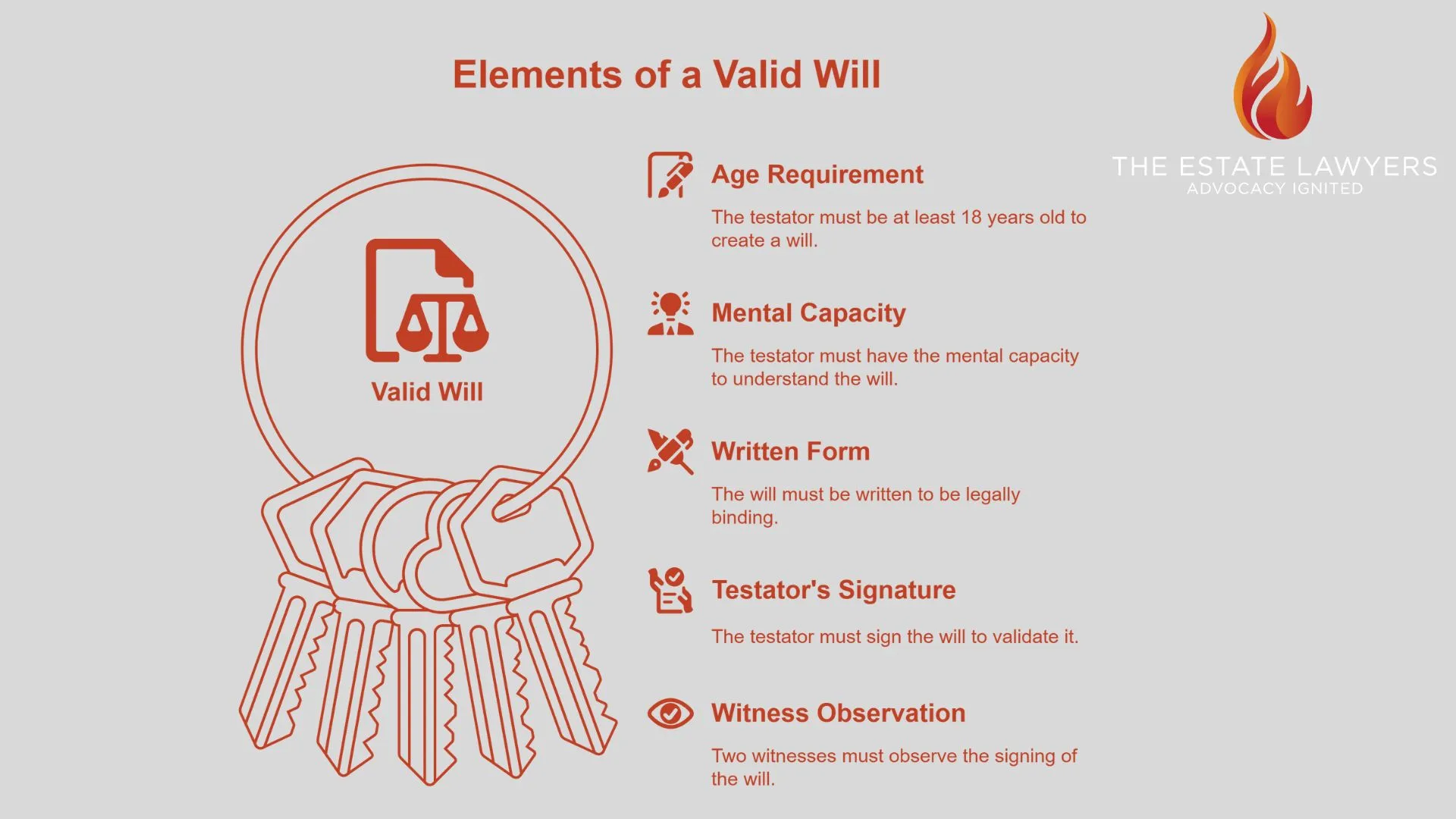
A will in California is legally binding only when it meets five core requirements:
- The testator must be at least 18 years old.
- The testator must have mental capacity.
- The will must be in writing.
- The testator must sign the will.
- Two witnesses must observe the signing.
The Testator’s Age and Capacity
To create a valid will, the testator must be 18 years or older and of sound mind. California restricts will-making to adults who understand:
- The nature of creating a will
- The extent of their property
- Who should logically inherit from them
This mental capacity rule protects seniors and vulnerable adults from undue influence or exploitation. In cases involving memory loss or elder abuse, a will can be invalidated if the court finds the testator lacked capacity or was coerced.
At The Estate Lawyers, APC, we frequently litigate disputes over capacity and influence. Our attorneys collaborate with medical professionals and witnesses to present clear evidence of intent, protecting both the elderly and rightful beneficiaries when capacity is questioned.
Written Form and Signature
California requires that every valid will be in writing, either typed or handwritten, and signed by the testator. Typed wills must also be witnessed by two people who see the testator sign or acknowledge the will.
A handwritten, or holographic, will can still be valid without witnesses, as long as the testator personally writes and signs all material portions. However, handwritten wills often lead to disputes over legibility, unclear intent, or missing information.
Witness Requirements
Two adult witnesses must be present at the same time and must observe the testator’s signing, or hear the testator confirm that the signature is theirs. Each witness must also sign the will themselves.
Witnesses should be “disinterested,” meaning they are not beneficiaries under the will. If a beneficiary acts as a witness, their gift may be voided unless two other independent witnesses can verify the signing.
According to the American College of Trust and Estate Counsel (2023), nearly 20% of self-prepared wills in California fail due to improper witness execution, a simple but costly mistake that can make the will unenforceable.
At The Estate Lawyers, APC, we make sure every witness requirement is properly documented and verifiable, protecting families from future contestations.
Can a Will Be Notarized?
Many Californians believe that notarization can replace witnesses, it cannot.
A notarized will does not meet California’s legal execution standards unless it’s also properly witnessed.
Notarization can, however, strengthen a will’s authenticity by adding a self-proving affidavit, which helps streamline probate verification later.
Our firm often includes notarized affidavits for clients as part of a complete estate plan, but always in addition to, not instead of, qualified witnesses.
Special Types of Wills Recognized in California
While most Californians use a typed, witnessed will, state law recognizes a few other forms, each with unique rules and potential risks.
Understanding these differences is necessary to confirm your loved one’s wishes are respected and your estate plan holds up in court.
Holographic (Handwritten) Wills
A holographic will is one that is entirely handwritten and signed by the testator. A handwritten will can be valid even without witnesses, if the material provisions and signature are in the testator’s handwriting.
Advantages
- Easy to create in emergencies.
- No witnesses required.
- Recognized by California courts if handwriting can be proven authentic.
Risks
- Ambiguity: unclear handwriting or wording can lead to disputes.
- Missing legal language: terms like “executor,” “beneficiary,” or property descriptions often lack precision.
- Fraud potential: handwriting verification can become contentious in probate court.
At The Estate Lawyers, APC, we regularly litigate over holographic wills that family members dispute. Even when written with good intentions, unclear or incomplete language can trigger costly legal battles. Our team advises clients to formalize handwritten wills promptly through a legally executed version to prevent future conflict.
Electronic (Digital) Wills
In 2020, California introduced Assembly Bill 1667, allowing certain electronic wills, digitally signed and witnessed under strict procedures.
These wills are valid only if they:
- Are created and signed electronically by the testator.
- Include electronic signatures from two qualified witnesses.
- Are stored in a secure, tamper-proof digital format.
Oral (Verbal) Wills
California does not recognize oral wills.
Even if spoken before witnesses or recorded, a verbal declaration of last wishes carries no legal standing in California courts. The state’s laws require written evidence of testamentary intent.
If a loved one passes away after making only verbal promises, their estate will likely be distributed according to California’s intestacy laws, not their spoken wishes.
This can lead to deeply unfair outcomes, especially in blended families or where long-term partners are not legally married.
Key Comparison: Types of Wills in California
| Will Type | Recognized by Law? | Witnesses Required? | Key Risk Factor |
| Typed Will | Yes | 2 adult witnesses | Missing or unqualified witnesses |
| Holographic (Handwritten) Will | Yes | No | Ambiguity or missing language |
| Electronic Will (AB 1667) | Yes (since 2020) | 2 digital witnesses | Technical noncompliance |
| Oral (Verbal) Will | No | N/A | Not legally recognized |
7 Common Mistakes That Make a Will Invalid in California
Below are the most common mistakes that can make a California will invalid, and how to avoid them.
1. Missing or Improper Witnesses
A typed will must be signed by the testator and witnessed by two adults present at the same time.
If even one witness is missing, or if they sign at different times, the will can be contested and potentially thrown out.
At The Estate Lawyers, APC, we frequently see this issue arise in do-it-yourself estate plans and online templates. Our attorneys make sure every witness requirement is properly executed, verified, and documented, so your will holds up when it matters most.
2. Beneficiaries Acting as Witnesses
California law allows a beneficiary to serve as a witness, but doing so can create conflicts. If a witness stands to inherit under the will, the court may presume undue influence, potentially voiding their gift.
This is one of the simplest yet most damaging mistakes we see. Family members “help” sign as witnesses without realizing it jeopardizes their own inheritance.
3. Missing Signature or Incomplete Execution
A will is not valid without the testator’s signature. Even a perfectly written and witnessed document can fail if the signature is missing, misplaced, or incomplete.
Digital or scanned copies also cause issues if the original signed version cannot be produced.
At The Estate Lawyers, APC, we’ve litigated estate disputes where a single missing signature led to years of probate battles. When we draft or review a will, our attorneys verify every detail, from ink to initials, to confirm the document’s enforceability.
4. Using an Out-of-State or Online Template
Many Californians use free online will templates or kits from other states. Unfortunately, these often omit state-specific clauses, lack proper witness language, or use outdated requirements.
5. Unclear or Conflicting Language
Phrases like “divide equally among my children” or “my property” might sound simple, but ambiguity invites litigation.
If a will’s language is vague or inconsistent with prior documents (like trusts or beneficiary designations), courts must interpret intent, often leading to prolonged disputes.
6. Failing to Update After Major Life Events
Marriage, divorce, new children, and property purchases can all render parts of a will outdated or invalid.
California courts have ruled that wills failing to address changed circumstances, such as remarriage or the birth of a new child, can trigger partial intestacy, where property is distributed by default law instead of the testator’s wishes.
We recommend reviewing and updating your will every 3–5 years or immediately after major life events. Our attorneys help clients keep their estate plans current so that evolving family situations never jeopardize their intentions.
7. Ignoring Legal Advice
Perhaps the biggest mistake of all: assuming that will creation is a do-it-yourself project.
The law doesn’t forgive technical errors, and probate courts don’t correct mistakes, they enforce statutes.
Why You Need a California Estate Planning Lawyer
Writing a will on your own might seem simple, but one missing signature, witness, or phrase can make it invalid under California law.
An experienced estate planning lawyer, makes sure your will meets every legal requirement, reflects your true wishes, and stands up in court if ever challenged.
At The Estate Lawyers, APC, we go beyond drafting documents, we protect your legacy, prevent family disputes, and give you the confidence that your loved ones will be cared for exactly as you intend.
Protect Your Legacy
Your will deserves more than a template. It deserves the precision, protection, and experience of attorneys who live and breathe California estate law. At The Estate Lawyers, APC, we’ve spent decades protecting families, resolving disputes, and defending legacies in and out of court.
Schedule a confidential consultation today, and get the clarity, confidence, and peace of mind your family deserves.
The Estate Lawyers: Here to Guide. Here to Fight. Here for You.