



For a death in 2027, the California probate threshold under Probate Code 13100 is $208,850. It does not change until April 1, 2028.
Sorting out paperwork after a death is heavy work, and checking the figure first is a sound instinct. A wrong number is how probate disputes between heirs start.
Some sites list $166,250 or $239,700, and neither matches the statute for a 2027 death. Your first step is to list every asset and how it is titled. A second limit also exists: the primary residence rule lets a home worth $750,000 or less pass by court petition.
What Is The California Probate Threshold For 2027?
The threshold for 2027 is $208,850 under Probate Code 13100 for any death that year. That figure has applied since April 1, 2025. No adjustment takes effect in 2026 or 2027.
Probate Code 890 adjusts these dollar amounts every three years, and the next adjustment takes effect April 1, 2028. The date of death picks the limit. The date you file or the date a bank releases funds does not.
The Judicial Council of California announced on May 8, 2025 that the Affidavit for Collection of Personal Property limit rose to $208,850, up from $184,500, effective April 1, 2025. The Council publishes each adjusted amount along with the court forms.
Deaths from April 1, 2022 through March 31, 2025 use $184,500. Deaths on or after April 1, 2025 use $208,850, which covers every death in 2027. The figure $166,250 is an older limit, and $239,700 assumes a 2026 adjustment that does not exist.
Which Assets Count Toward The Probate Threshold?
Only the probate estate counts. That is California property in the decedent’s sole name, after the exclusions in Probate Code 13050.
Six kinds of property are left out, either under Probate Code 13050 or because they pass outside probate:
- Property held in a living trust
- Property held in joint tenancy
- Payable-on-death and transfer-on-death accounts
- IRAs and life insurance with a named beneficiary
- Vehicles registered under the Vehicle Code
- Community or separate property passing to a surviving spouse
Value is measured as of the date of death under Probate Code 13051. Later gains or losses do not change the count.
Take a 2027 death with a $950,000 home in a living trust, a $300,000 life insurance policy and a $250,000 IRA, both with named beneficiaries, plus a $15,000 car. All four are excluded.
A $120,000 bank account in the decedent’s name and $18,000 of household items total $138,000. That is under $208,850, so the affidavit works even though total wealth tops $1.6 million.
Now change the facts. A $200,000 account plus $12,000 of belongings totals $212,000. That is $3,150 over $208,850, so the affidavit is unavailable and formal probate is required.
Write down each asset, how it is titled and any beneficiary named. The deed, trust, account statements and beneficiary forms set the count.
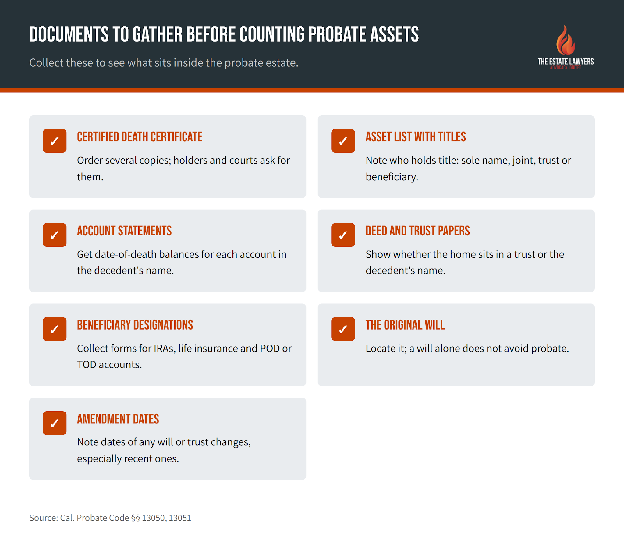
Figure 1: Title and beneficiary forms decide what counts toward the threshold. Source: Cal. Probate Code §§ 13050, 13051.
How Is The Right Probate Route Chosen?
Two numbers choose the route: countable assets and the home’s value on the date of death. Each route uses a different document, and there are three branches:
1. Countable assets at or below $208,850: use the Probate Code 13100 affidavit after a 40-day wait.
2. A primary residence worth $750,000 or less: file a Petition to Determine Succession to Real Property, and a court order transfers the home.
3. Either limit exceeded, or a petition for a personal representative pending: open formal probate.
The home test uses the gross fair market value of the residence at death. The affidavit test counts all non-excluded assets. The two tests are applied separately and never added together.
Affidavit Process Under Probate Code 13100
The affidavit process has two stages. First comes a 40-day wait after death. Then a signed declaration goes to each holder of the decedent’s property.
A qualifying successor signs the affidavit under penalty of perjury. The holder, such as a bank, receives it with a certified death certificate and releases the property to the successor.
This affidavit generally cannot move a home. The Judicial Council of California reported on May 8, 2025 that the separate Affidavit Regarding Real Property of Small Value limit rose to $69,625, up from $61,500, effective April 1, 2025.
Residence Petition Covers $750,000 Homes
The residence petition covers a primary residence worth $750,000 or less. A court order, not an affidavit, moves title.
AB 2016 created this route. The Judicial Council of California reported on May 8, 2025 that the limit rose to $750,000, up from $184,500, effective April 1, 2025.
The measure is the home’s gross fair market value at death. The mortgage is not subtracted. The home must have been the decedent’s primary residence.
The petition is filed in the Superior Court of the county where the decedent lived, such as Orange or San Diego. A hearing is required. Hearing dates follow each court’s calendar, so confirm the current wait with the local probate clerk.
Formal Probate Applies Above Either Limit
Formal probate applies when countable assets exceed $208,850, the home exceeds $750,000, or a petition for a personal representative is pending. The court then issues letters, the court papers that give a personal representative authority over estate assets.
Only a probate estate above the limits needs this process. A will alone does not avoid probate.
If probate is required and never opened, title stays frozen and no one has authority to act. Creditors have four months after letters issue to file claims under Probate Code 9100. Closing typically takes 12 months or more, and handling formal probate administration means court filings throughout.
Timing differs sharply by route. The affidavit can release funds soon after day 40.
The residence petition waits on a hearing date. Formal probate cannot close until the claim period ends.
| Route | Applies when | Title moves by | Timing |
|---|---|---|---|
| Small estate affidavit | Countable assets $208,850 or less | Signed declaration to each holder | 40-day wait after death |
| Residence petition | Primary residence $750,000 or less | Court order after hearing | Hearing; confirm with local court |
| Formal probate | Either limit exceeded | Court letters, then distribution | Four-month creditor period; often 12 months or more |
Figure 2: The same estate can take weeks or more than a year depending on the route. Source: Cal. Probate Code §§ 9100, 13100, 13150; Judicial Council of California, 2025.
What Goes Wrong After A Small Estate Affidavit?
The transfer can be challenged. Under Probate Code 13109, the person who collected property by affidavit can be personally liable to anyone with a superior right to it.
Only a qualifying successor may sign. Undervaluing an asset to stay under the limit can void the transfer.
A sibling left out of an affidavit can challenge it and recover the property. That is the basis of an omitted heir’s claim. Our litigation team starts with evidence: affidavit copies, bank records and financial tracing to show where the property went.
Which Edge Cases Change The Threshold Answer?
Four edge cases change the answer:
- Unfunded trust property: an asset meant for the trust but still in the decedent’s name may need a Heggstad petition under Probate Code 850. A trust petition of this kind makes the threshold only part of the analysis.
- A surviving spouse: community property passing to a spouse can bypass the threshold through a spousal property petition.
- A non-resident decedent: California property is measured against the same $208,850 threshold, and the home state’s rules apply separately.
- Heirs who disagree, or an elder pressured into changing ownership: the affidavit route is risky, and disputed non-probate transfers need records reviewed first.
Two related limits also moved. The Judicial Council of California reported on May 8, 2025 that the Small Estate Set-Aside limit (Probate Code 6600 to 6613) rose to $107,900. The Excluded Salary/Compensation limit (Probate Code 13050(c), 13600 to 13601) rose to $20,875, both effective April 1, 2025.
Does California Have An Estate Tax In 2027?
No. California has no estate tax and no inheritance tax in 2027. The federal estate tax exemption is a separate figure set by the IRS, so check the current IRS figure for 2026 and 2027 directly with the IRS.
The small estate threshold has no relation to that exemption. One decides whether a court process is needed. The other decides whether federal tax is owed.
Frequently Asked Questions
What Is Probate?
Probate is the court process that gives a personal representative authority to collect assets, pay debts and distribute property. It covers only assets in the decedent’s name with no trust or beneficiary. Whether it applies depends on the $208,850 threshold and the three routes above.
How Do Wills Work In California Probate?
A will states who inherits, but it does not avoid probate. The court reviews the will when probate is required, and a small estate can still pass by affidavit even with a will. A will can also be contested in court.
When Heirs Dispute A Small Estate
When heirs dispute a small estate, the first move is to get the records. Questioning paperwork after a death is hard, and your instinct to check is sound. Gather the deed, trust papers and beneficiary forms now, and note the date of every ownership or beneficiary change.
Our trust and estate litigators review any affidavit, trace the funds and file quickly when assets are at risk, because funds already moved are harder to recover. Bradley R. Kirk has taken more than 100 cases to trial in probate court.
If you face an inheritance dispute, Let Us Resolve Your Probate Dispute. Call Irvine at (949) 785-2009 or San Diego at (858) 351-4006. Here to guide.
Here to fight. Here for you.