


A holographic will, meaning a handwritten will, is valid in California under Probate Code § 6111 without witnesses. A notary stamp does not make a will valid, because § 6110 requires two witnesses, and that rule sits at the center of what makes a will legal in this state. If a loved one left a handwritten page, your family may not know whether it counts.
Our trust and estate litigators see these wills fail in probate court, and the same few defects decide the outcome when a will contest is filed. This post covers those defects, the notary myth and the deadlines that start at death. It applies California law only.
Is A Holographic Will Valid In California?
Yes. A holographic will is valid under Probate Code § 6111 if the testator’s signature and material provisions are in the testator’s own handwriting.
The testator is the person who signs the will. No witnesses are required.
The testator must be 18 or older and of sound mind (§§ 6100, 6100.5). Capacity is the usual contest issue, because the page rarely shows the writer’s mental state.
What Must Be Handwritten?
The signature and the material provisions must be in the testator’s handwriting. Material provisions are who gets what and who serves as executor.
A typed or preprinted form with handwritten fill-ins is risky. The court asks whether the handwritten words alone show the plan.
Typed text that no one witnessed does not count as handwriting. It can be saved only under § 6110(c)(2).
Is An Undated Holographic Will Valid?
Yes, usually. Under § 6111(b), an undated holographic will is invalid only to the extent it conflicts with another will, unless it is shown to be later. It is also invalid if the testator lacked capacity at any time it might have been signed, unless its date is shown to fall within a period of capacity.
Take a father whose typed will pours everything into his trust. After his death, the family finds an undated handwritten note beside it leaving the house to one daughter. He received a dementia diagnosis that same year.
The date decides the case. If the note came first, the typed will controls where they conflict. If the note came later, it can pass the house, but only if he had capacity on the day he wrote it.
Dated letters, checks, medical charts and handwriting exemplars prove the date. Exemplars are known samples of the testator’s writing. The same records drive how courts assess capacity, which looks at the testator’s mind when the will was signed.
Does Notarization Make A California Will Valid?
No. A notary acknowledgment does not satisfy § 6110, and the will still needs two witnesses present at the same time. A notary adds identity evidence, not validity.
States that follow Uniform Probate Code § 2-502(a)(3)(B) accept a notary acknowledgment instead of witnesses. California did not adopt that option, so advice from those states does not carry over.
A notarized typed will without witnesses is not validly executed. It survives only under § 6110(c)(2), on clear and convincing evidence that the testator intended the paper as a will. A notarized handwritten will is still tested as a holographic will under § 6111.
The notary does add evidence. The notary checked identification and logged the signing in a dated journal. Subpoenaing those records can place the testator at a signing on a specific day, which matters when the date or identity is disputed.
What Does § 6110 Require?
A witnessed will is in writing, signed by the testator, and witnessed by two people present at the same time who understand it is the testator’s will. An attestation clause, the witnesses’ written statement in the will describing the signing, makes later proof easier. It matters most when the witnesses cannot be found years later.
How Must Two Witnesses Sign?
Both witnesses must be present at the same time when the testator signs or acknowledges the signature. They then sign, knowing the document is the testator’s will, during the testator’s lifetime.
Two signatures collected separately on different days are a common defect. That defect invites a contest.
What If A Beneficiary Witnesses?
The will stays valid, but § 6112 raises a presumption of undue influence unless two other disinterested witnesses also signed. Undue influence means pressure that replaces the testator’s wishes with someone else’s.
Consider an $800,000 estate, no spouse and two adult children. The will leaves everything to Dana, one of the children, who is also one of the two witnesses. Only one witness is disinterested, so the presumption arises.
Unless Dana rebuts it, she takes no more than her intestate share, $400,000. Had two other disinterested witnesses also signed, the presumption would not arise. A beneficiary who witnessed the will can still defend the full gift with evidence of a fair, independent signing.
How Do The California Will Methods Compare?
A typed will with two witnesses holds up best. A typed will with only a notary, or with no witnesses, holds up worst.
Handwritten wills fall between, because they depend on proof of handwriting. A notary stamp does not move a typed will up this ranking.
| Method | Statute | Who testifies | Contest vulnerability |
|---|---|---|---|
| Typed, two witnesses | § 6110 | Witnesses or attestation clause | Lowest; capacity and undue influence only |
| Typed, notary only | § 6110(c)(2) only | Notary and people who know intent | High; not validly executed |
| Handwritten, unwitnessed | § 6111 | Handwriting witness or expert | High; forgery, capacity, date disputes |
| Handwritten, two witnesses | § 6110 or § 6111 | Witnesses; handwriting if needed | Lower; two statutes support it |
| Typed, unwitnessed | § 6110(c)(2) | People with knowledge of intent | Highest; clear and convincing proof |
Figure 1: Only two witnesses or a qualifying handwriting give a will a secure footing; everything else invites a contest. Source: Cal. Prob. Code §§ 6110, 6111.
What Happens To A Holographic Will After Death?
The person holding the original must deliver it to the superior court clerk within 30 days of learning of the death (§ 8200). The court then decides whether to admit it. Once filed, the will is a public court record in the Orange County or San Diego County probate court.
Admission rests on proof of handwriting and signature. A lay witness who knows the handwriting can testify (Evid.
Code § 1416). The court or a handwriting expert can also compare the will with exemplars (§§ 1417-1418).
An interested person has 120 days after admission to contest (§ 8270). The usual grounds are lack of capacity, undue influence and forgery. Deciding which contest theory fits depends on records gathered in the first weeks.
The order is delivery within 30 days, a petition, proof of handwriting and then the 120-day contest window.
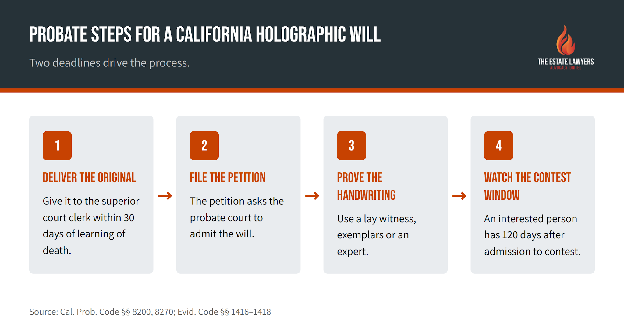
Figure 2: Deliver the original within 30 days, then watch the 120-day contest window. Source: Cal. Prob. Code §§ 8200, 8270; Evid. Code §§ 1416–1418.
Keep the original safe and unmarked, and write down where and when it was found. Preserve exemplars, dated letters and medical records now. They get harder to locate as time passes.
Do Handwritten Edits Change A California Will?
Only some do. A pen strike-through of a gift can revoke that gift by cancellation (§ 6120), but a handwritten new gift in the margin usually has no effect. The new gift works only if it qualifies as a holographic codicil, a handwritten amendment, under § 6111, with material provisions handwritten and signed.
Suppose a typed, witnessed will leaves $50,000 to a nephew. The testator strikes it and writes an unsigned margin note giving it to a neighbor. The struck gift fails, the new gift fails, and the $50,000 passes by the residuary clause or by intestacy.
The residuary clause gives away everything the will does not leave elsewhere. The safe fix has three parts:
- Leave the original will unmarked.
- Sign a new witnessed codicil or a new witnessed will.
- Destroy nothing, so the document’s history can be proved.
Is A California Holographic Will Valid Elsewhere?
Sometimes. A California court admits a will valid under the law of the place of execution or of the testator’s domicile, abode or nationality (§ 6113). Other states apply their own rules.
The reverse is harder. A California holographic will covering real property in a state that rejects holographic wills, such as Florida or New Mexico, is recognized there only if that state’s foreign-will statute allows it. Ancillary proceedings, meaning a second probate in that state, may then require a witnessed will.
Check any list of states that reject holographic wills before relying on it. A move to another state also changes the analysis.
Challenging Or Defending A Handwritten Will
Worry that a loved one’s last words are being doubted is natural, and the answer is evidence. Our probate litigation attorneys prove or disprove handwriting, date and capacity with depositions, exemplars, medical records and notary records. Bradley R. Kirk has taken more than 100 cases to trial in probate court, and we file before the 120-day window closes.
Start now by gathering the original will, noting every date tied to it and saving dated letters and medical records.
Here to guide. Here to fight. Here for you.