



California trust and estate law in 2027 keeps its core contest and accounting clocks, adds any bills signed in the 2026 session on January 1, 2027, and resets a few dated figures. We are writing in November 2026 and treating 2027 as the year ahead, building on last year’s changes.
Timing decides trust cases. Early action preserves assets and evidence, and delay helps whoever is moving the money.
When our litigation team is litigating a trust dispute, we stay up to date.
What Changes In California Trust Law In 2027?
The only changes are bills signed in the 2026 session, which take effect January 1, 2027 under Cal. Const. art. IV, sec. 8(c), plus a few dated figures. The contest clocks, the trustee’s accounting duty and the absence of a California estate tax stay as they are.
Many “2027 updates” only repeat existing rules. Anything not on the dated calendar below is unchanged.
Do California’s 2027 Tax Figures Change?
Yes, some do. The federal basic exclusion is indexed from its $15 million per person level, and the Prop 19 value cap resets February 16, 2027. California still imposes no estate tax.
There are six dated items for 2027:
- Federal basic exclusion: $15 million per person in 2026, indexed for inflation from 2027. Source: the IRS, which announces the 2027 figure in the fall.
- Annual gift exclusion: $19,000 per recipient is the 2026 figure. Treat it as the 2026 figure until the IRS publishes the 2027 amount.
- Prop 19 value cap: resets February 16, 2027, and every two years after that. Source: the State Board of Equalization (BOE).
- Small estate threshold: $208,850, fixed until April 1, 2028. Source: Probate Code 13100.
- California estate tax: none, with no change scheduled for 2027.
- New statutes: 2026-session bills take effect January 1, 2027. Source: Cal. Const. art. IV, sec. 8(c).
Which 2026 Bills Become 2027 Law?
Only bills the Governor signed and the Secretary of State chaptered. Verify each one on leginfo.legislature.ca.gov before anyone relies on it.
As of this writing, we have not verified a chaptered 2026 Probate Code or Welfare and Institutions Code bill to list here. We list none rather than repeat pending or rumored bills. Run three checks on leginfo.legislature.ca.gov:
- Status: the bill shows “Chaptered” with a chapter number.
- Sections: the bill amends the Probate Code or the Welfare and Institutions Code.
- Operative date: the bill’s text states when, and to which matters, it applies.
What Deadlines Run After A Settlor Dies?
A revocable living trust becomes irrevocable at the settlor’s death. The trustee then has 60 days to serve notice, and that notice starts a 120-day window for a trust contest.
The settlor is the person who made the trust. A trust contest is a court challenge to whether the trust, or a change to it, is valid.
How Does A Trustee Start Administration?
In four steps. The will is lodged within 30 days of death, notices go out within 60 days, assets are retitled under a new EIN, and accountings follow.
1. Lodge the will: the person holding the original will delivers it to the superior court clerk within 30 days of learning of the death (Prob. Code 8200).
2. Serve notice: the trustee serves Probate Code 16061.7 notices on beneficiaries and heirs within 60 days.
3. Get an EIN and retitle: the trust takes its own federal tax number, and accounts and real property move into the trustee’s name.
4. Account: the trustee sends accountings under Probate Code 16062, at least once a year and at termination.
An accounting is a written report of what came in, went out and remains. Section 16062 is the source of a beneficiary’s right to accountings, and a court can order one when it is not sent.
One trap affects both sides. A report starts the three-year claim period under Probate Code 16460 only if it adequately discloses the potential claim. A good-faith trustee with imperfect records is better protected by full disclosure than by a thin report.
Some assets never reach the trust. When the settlor declared an asset trust property but never retitled it, a Heggstad petition under Probate Code 15200 asks the court to confirm it belongs to the trust.
When Does A Contest Window Close?
It closes 120 days after the trustee’s notice or 60 days after a requested trust copy is delivered, whichever is later (Prob. Code 16061.8). The later date controls.
Take a settlor who dies March 1, 2027. The notice is due April 30, and a beneficiary served May 1 has 120 days, ending August 29. That day is a Sunday, so confirm the roll-forward under Code of Civil Procedure 12a.
If that beneficiary requested the trust copy May 1 and received it by mail July 15, the 60-day window ends September 13. That date is later, so it controls.
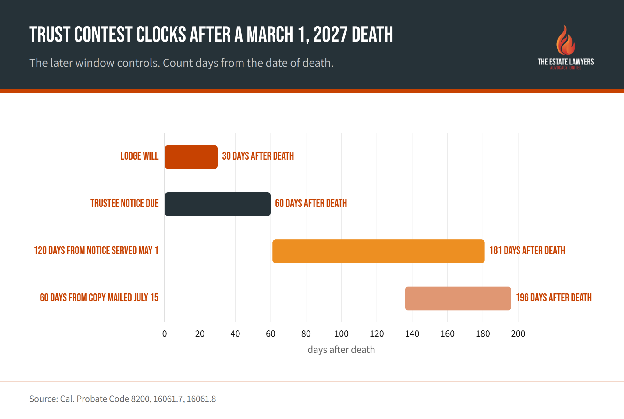
Figure 1: A trust copy mailed July 15 pushes the contest deadline to Sept 13, later than Aug 29. Source: Cal. Probate Code 8200, 16061.7, 16061.8.
A will follows its own clock. A petition to revoke probate must be filed within 120 days after the will is admitted (Prob. Code 8270).
We check each date against the proof of service, because a missed deadline ends a contest no matter how strong the facts are. Contesting a trust is a narrow window, not an open door.
Which Petitions Trigger A No-Contest Clause?
Three acts can trigger a no-contest clause under Probate Code 21311: a direct contest without probable cause, a pleading that property was not the transferor’s, and a creditor’s claim. The last two count only if the clause expressly covers them.
Probable cause means the known facts would lead a reasonable person to believe the requested relief is reasonably likely to be granted after further investigation or discovery. A 17200 petition asking for an accounting or the removal of a trustee is generally not a direct contest.
Families mix up these filings. One grid separates the will contest, the trust contest and the 17200 petition by statute, trigger, deadline, standing and contest status.
| Attribute | Will contest | Trust contest | Accounting petition |
|---|---|---|---|
| Statute | Prob. Code 8270 | Prob. Code 16061.8 | Prob. Code 17200 |
| Trigger | Will admitted to probate | Trustee notice or trust copy | Trustee fails to account |
| Deadline | 120 days after admission | Later of 120 or 60 days | 3 years after adequate report |
| Who may file | Interested person | Interested person | Beneficiary |
| Counts as contest | Yes, if no probable cause | Yes, if no probable cause | Generally no |
Figure 2: A petition for an accounting is generally not a direct contest. Source: Cal. Probate Code 8270, 16061.8, 17200, 21311.
These petitions are filed in the county probate department, such as Orange County or San Diego Superior Court. Read the posted probate note before the hearing. Risk starts with the exact wording of the clause, which our guide to assessing no-contest clause risk walks through.
How Does Prop 19 Affect An Inherited Home?
A child keeps the parent’s low assessed value only by making the home a principal residence. Value above the adjusted cap is added to the assessment.
Take a factored base year value of $300,000 and a market value at death of $1,800,000. Using a $1 million cap for simplicity, the new assessed value is $300,000 plus ($1,800,000 minus $1,300,000), or $800,000. At about 1%, that is roughly $8,000 a year instead of $18,000.
According to the BOE, the adjusted cap is $1,044,586 for transfers from February 16, 2025 through February 15, 2027. With that figure, the assessed value is $755,414, about $7,554 a year.
Transfers on or after February 16, 2027 use the reset figure. The claim goes on form BOE-502-A, and the filing deadline should be confirmed on the form.
The exclusion ends if the home is sold or stops being the child’s principal residence. The home is then reassessed.
The child must move in within one year. A trust contest or sibling dispute over who gets the house can outlast that window, and the lost exclusion is a real result of delay. Disputes over estate property need early decisions about occupancy, which we cover in real estate disputes in estates.
When Is A Trust Change Financial Elder Abuse?
When someone takes or obtains an elder’s property for a wrongful use or with intent to defraud, as defined in Welfare and Institutions Code 15610.30. Obtaining property through undue influence also qualifies.
Section 15657.5 lets the court order the wrongdoer to pay the elder’s reasonable attorney charges and, with the required findings, enhanced damages. Probate Code 259 can bar the abuser from inheriting.
Take a trust amendment arranged by a caregiver and signed weeks before death. A suspiciously timed amendment is a reason to investigate, not proof of wrongdoing. The evidence that matters is the capacity timeline, who arranged the signing, and the medical records.
You are not overreacting. Our litigation team handles financial elder abuse claims by getting the records first and filing quickly when assets are at risk.
Frequently Asked Questions
Should Trusts Be Updated For 2027?
Yes, when a trigger applies. The four triggers are the higher federal exemption, a Prop 19 home transfer, assets never retitled into the trust, and a successor trustee who can no longer serve. Review those four, not the calendar.
Can Small Estate Affidavits Replace Probate?
Yes, when the estate qualifies. For deaths on or after April 1, 2025, the threshold is $208,850 until April 1, 2028, measured by date of death, and a 40-day wait applies. Assets above the threshold need a court process.
Next Step When A Trust Becomes A Dispute
Write down three dates: the settlor’s death, the trustee’s notice, and any trust copy request. Those dates set your clocks.
At The Estate Lawyers, APC, every case is prepared for trial, and evidence is gathered first. Amy L. Gostanian has been a State Bar of California Certified Specialist since 2010, and Bradley R. Kirk has tried more than 100 probate cases. Our estate litigation team can review the dispute and the first moves.